Stacks’ Bitcoin Staking Whitepaper: Self-Custodial BTC Yield, Funded by STX Economics

Stacks has released a whitepaper for self-custodial Bitcoin Staking, a proposed upgrade to its Proof-of-Transfer consensus mechanism that would let BTC holders earn BTC-denominated yield while keeping native BTC locked on Bitcoin L1.
The TLDR:
Users will be able timelock BTC on the L1.
Must also lock 5% in the STX token to gain access to yield.
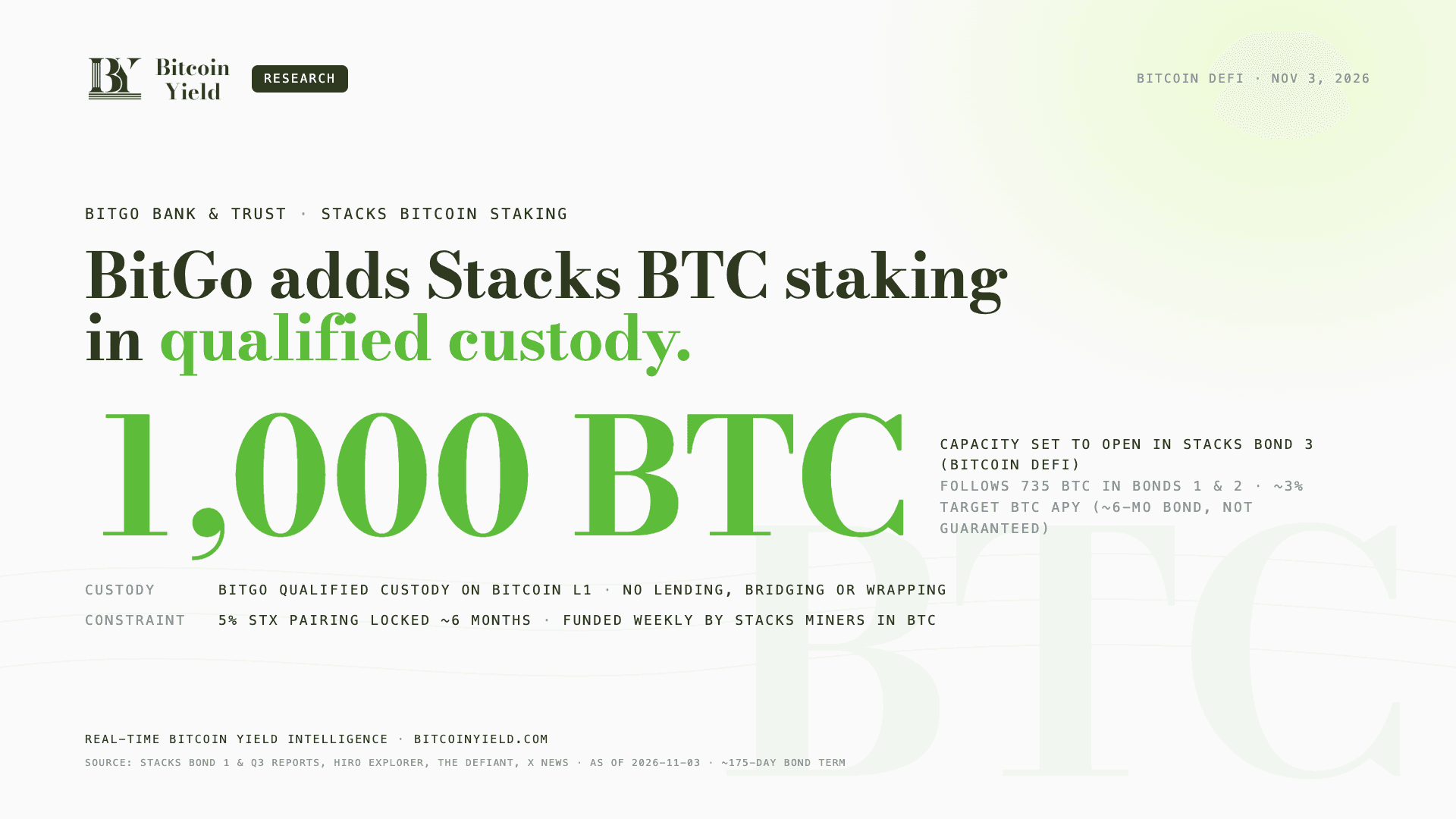
Earn an estimated 3% APY. Depends on Stacks miner economics.
The design is a welcome addition to the market and worth exploring. It is self-custodial on the BTC side, it has a visible source of yield, and it builds on a live PoX system that has distributed BTC rewards since the Stacks network went live in 2021.
To be clear. This is not a BTC-only product. It requires staking an altcoin to participate.
What The Whitepaper Proposes
Under today’s Stacks PoX system, miners spend BTC to compete for STX block rewards and transaction fees. That BTC is distributed to eligible STX stackers, as well as those participating in Dual Stacking today.
Self-custodial Bitcoin Staking changes the model.
The proposed mechanism introduces “protocol bonds.” A participant locks BTC on Bitcoin L1 using a timelocked UTXO and pairs that position with locked STX on Stacks. The BTC remains under the participant’s own keys. The STX asset being locked gains you access.
This is a big divergence from the historic process where a user would lock STX, and earn BTC. This user now only earns after the protocol bonds have been paid out.
The whitepaper proposes some initial targets:
- 3,000 BTC initial capacity
- 5% minimum STX pairing ratio
- 3% target BTC APY
- 6-month bonding periods
- Managed structure through the recently formed Endowment
- Later transition toward a permissionless auction system
Where The Yield Comes From
The source of yield is not new.
The yield comes from the existing PoX consensus mechanism. Stacks miners pay BTC to compete for STX block rewards and transaction fees. Those miner-paid BTC flows fund the reward pool.
That means the durability of the yield depends on:
- STX block rewards
- STX market price
- Stacks transaction fees
- Miner competition
- Reserve coverage
- Available BTC capacity
This is the key insight. BTC custody risk is reduced because the BTC can remain on Bitcoin L1. But economic risk remains because the yield is tied to STX economics.
Does This Replace Dual Stacking?
Dual Stacking is the main way Stacks projects that we cover are offering yield currently.
We have confirmed from Stacks members involved in the process, when this product goes live. The current Dual Stacking mechanism will be sunset. This means that most of the yield currently accruing to Zest, and partially to Hermetica, will be meaningfully reduced.
Comparison: Stacks vs Babylon vs Lightning
With this whitepaper, Stacks enters a small but growing category: self-custodial Bitcoin yield. The closest comparisons are Babylon and Lightning, but the mechanisms are very different.

Babylon and Lightning allow BTC to be the main input. Stacks requires an additional asset.
Babylon asks BTC holders to accept validator slashing risks, though they are capped at .1%. Lightning asks BTC holders to manage liquidity and operational complexity. Stacks asks BTC holders to accept STX exposure in exchange for BTC-denominated yield.
Each mechanism has a real tradeoff.
Stacks Bitcoin Staking is a welcome addition to the Bitcoin yield market.
Our Take (BitcoinYield Lens)
It is a self-custodial BTC yield product. Paid in BTC. This puts it in a group effectively by itself, with Lightning as the only other option that fits that description.
That said. It does require 5% exposure to an altcoin, STX here, to take advantage of it. Which first excludes it from being included in our database. Our mandate remains that BTC must be the only input asset required to earn.
We will report on this from a news angle and see how the market adopts it. The most promising thing about the positioning in this whitepaper is how easy it is to underwrite the risk you are taking on as a capital allocator.
Babylon has proven demand for self-custodial yield. We will see how the market reacts when the reward is BTC.
The open question is whether the market wants this structure at scale.
You can learn more about the latest self-custodial staking solution here.