Bitcoin Staking vs Lending vs DeFi Yield
Bitcoin staking, Bitcoin lending, and Bitcoin DeFi yield are three different BTC yield paths. Staking-style products usually pay from protocol security rewards or BTC-linked incentive systems. Lending pays from borrower interest. DeFi yield pays from trading fees, liquidity incentives, vault strategies, token emissions, or a mix of those sources.
The right comparison starts with the payer. If the yield comes from a security budget, you are underwriting protocol design. If it comes from borrowers, you are underwriting credit and collateral. If it comes from DeFi strategy, you are underwriting smart contracts, wrappers, liquidity, incentives, and execution.
As of the BitcoinYield homepage snapshot reviewed on July 2, 2026, the tracked Bitcoin yield market covered 23+ products, $4.95B+ in total TVL, and a 2.8% average APY. The visible board included Babylon at 0.05%, Zest Protocol at 1.62%, Lombard Bitcoin Earn at 2.29%, Sypher Capital Bitcoin Yield Fund at 4.35%, Amboss RAILS at 1.00%, and several YieldBasis vaults above 5%. Rates are point-in-time screen rates, not realized returns.
The Quick Comparison

What Bitcoin Staking Means
BitcoinYield defines Bitcoin staking as a BTC yield path where BTC or BTC-linked exposure supports a protocol security or reward mechanism. This is not native proof-of-stake. Bitcoin itself is proof-of-work, so BTC does not earn base-layer validator rewards the way a proof-of-stake asset does.
Babylon is the most direct example of the new category because the mechanism starts with BTC locking for external protocol security. Babylon describes its Bitcoin staking protocol as locking bitcoin to help validate other blockchains with no wrapping, pegging, or bridging. Lombard Finance then sits inside that ecosystem as a liquid-staking layer, giving users LBTC exposure around Babylon staking.
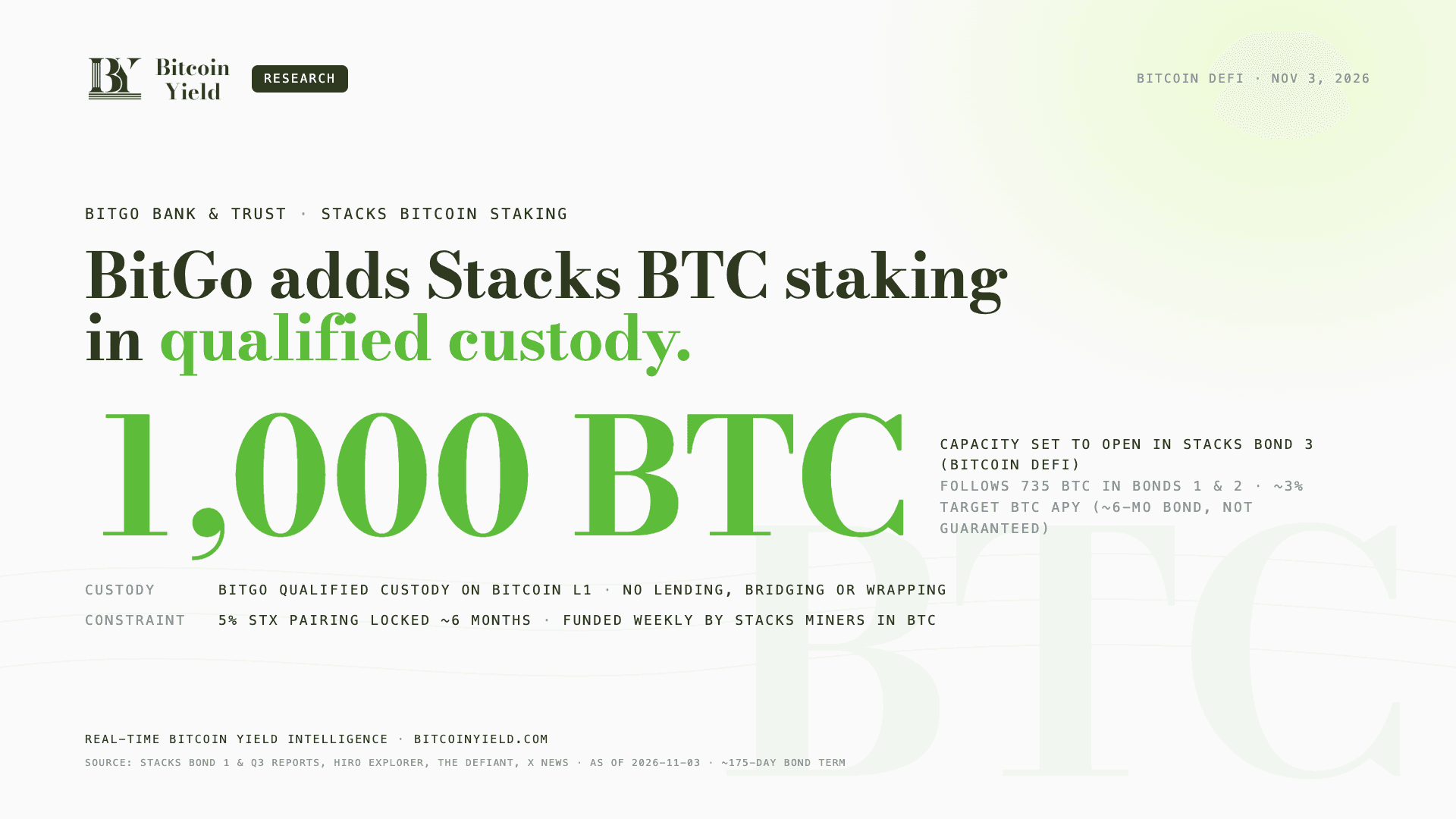
Stacks is another staking-style path, but the mechanism is different. Stacks Dual Stacking uses sBTC. The Stacks docs describe a process where users mint sBTC, enroll for baseline rewards, stack STX to boost returns, use sBTC in DeFi, and earn sBTC redeemable 1:1 for BTC.
Zest Protocol shows why the label needs precision. Zest is a lending protocol on Stacks, but BitcoinYield's product page showed its current yield source as mostly Stacks Dual Stacking, with lending interest only a small share. That makes Zest a useful example of a lending venue whose current supplier yield is mostly staking-linked.
Use staking-style products when: you can explain the protocol mechanism, the reward asset matches your objective, and the custody or bridge path fits your mandate.
Be careful when: a product uses staking language but the payout is mostly token emissions, manager discretion, or another yield route wearing a simpler label.
Relevant BitcoinYield pages:
What Bitcoin Lending Means
BitcoinYield defines Bitcoin lending as a BTC yield path where the return comes from borrower-paid interest. The borrower may be an individual, institution, DeFi user, trading firm, market maker, or vault strategy borrowing against collateral.
The strongest lending read starts with three questions:
- Who is borrowing?
- What collateral backs the loan?
- Who controls liquidation and recovery?
In DeFi lending markets such as Aave or Compound, suppliers provide liquidity and borrowers pay interest. Aave's documentation describes supplied assets earning interest from borrowing activity, while withdrawal depends on available unborrowed liquidity and active collateralization. Aave's rate model documentation also describes supply rates as derived from borrower interest after fees, with utilization measuring borrowed liquidity against total liquidity.
That is the lending model in its simplest form: borrowers pay, suppliers earn, collateral and utilization shape the risk.
Bitcoin lending becomes more complicated when the product moves offchain. A fund or centralized lending product may pay BTC-denominated yield, but the risk shifts toward manager controls, counterparty quality, rehypothecation policy, reporting, legal structure, and redemption terms. Those can be acceptable risks for institutions. They are not the same as onchain overcollateralized lending.
Use lending products when: the borrower base, collateral rules, liquidation process, custody path, and withdrawal terms are visible enough to underwrite.
Be careful when: the product advertises lending yield without showing borrower demand, collateral quality, or whether your BTC can be lent onward.
What Bitcoin DeFi Yield Means
BitcoinYield defines Bitcoin DeFi yield as BTC-linked return generated by smart-contract markets, vaults, liquidity pools, automated strategies, incentives, or basis trades. The user may start with BTC, but the deployed asset is often a BTC wrapper, liquid-staking token, vault share, LP position, or bridge asset.
This category is broad. It can include:
- BTC wrapper vaults
- liquidity provision
- basis carry
- lending-loop strategies
- token-emission programs
- automated vault allocation
- Lightning liquidity marketplaces
Lightning liquidity deserves its own mention. It is not DeFi in the Ethereum sense, but it is a BTC-denominated yield market. Lightning engineering docs describe Lightning Service Providers as entities that deploy liquidity for others, help open channels, and earn routing fees when forwarding payments. BitcoinYield's Amboss RAILS page showed ~1.00% APY, $3.83M TVL, a 30-day average withdraw time, and BTC as the reward asset.
Vault strategies sit at the other end of the category. YieldBasis token-yield vaults pay in YB emissions, while real-yield vaults pay in the underlying BTC wrapper. Both are DeFi yield, but they are not the same economic exposure. A token-paid 7% screen rate and a BTC-wrapper-paid 6% screen rate deserve different underwriting.
Use DeFi yield products when: you understand the wrapper, the smart contracts, the reward asset, the liquidity path, and the strategy's dependence on incentives or market spreads.
Be careful when: the product collapses multiple strategies into one headline APR without showing which route actually pays.
Relevant BitcoinYield pages:
The Main Difference Is the Failure Mode
The best way to compare these paths is to ask what has to go wrong for the yield to fail.

This is why APR alone is a weak sorting tool. Two products can both show 4% and have completely different failure modes.
Which Path Fits Which Holder?
Choose Bitcoin staking if you want mechanism clarity
Staking-style yield is often easiest to explain when the product is well designed. BTC or BTC-linked exposure supports a protocol mechanism and receives a defined reward asset. The tradeoff is that "staking" can hide very different custody and bridge assumptions.
Babylon, Lombard, Stacks Dual Stacking, and Zest all sit near this part of the map, but they should not be flattened into one bucket. Babylon is the core staking protocol. Lombard is the liquid-staking layer. Stacks Dual Stacking is an sBTC-based reward mechanism. Zest is a Stacks application whose current supplier yield is mostly Dual Stacking-linked.
Choose Bitcoin lending if you can underwrite credit
Lending yield is straightforward when the borrower and collateral are visible. It becomes harder when the product relies on private counterparties, opaque fund activity, or offchain lending desks. The question is whether the interest rate compensates for the credit and liquidity path.
The market history here matters. Crypto lending can look stable until the collateral path breaks or withdrawals slow. Serious BTC holders should read the legal structure and exit terms with the same attention they give the APY.
Choose Bitcoin DeFi yield if you accept complexity
DeFi yield can be more flexible and sometimes higher on screen, but the risk stack is usually wider. A single vault can include wrapped BTC, smart contracts, LP exposure, oracle assumptions, incentive tokens, bridge paths, strategy managers, and secondary-market liquidity.
That can still be attractive. It just belongs in the part of the portfolio sized for complexity.
A Simple Decision Rule
Use this rule before comparing rates:
- If you cannot name the payer, skip it.
- If the reward asset is not BTC or BTC-redeemable, size the token risk separately.
- If the custody path has a single point of failure, treat the yield as counterparty exposure.
- If the exit takes days or depends on liquidity, price the wait into the return.
- If the product combines multiple strategies, underwrite the weakest leg.
Then compare APR.
FAQ
Is Bitcoin staking safer than Bitcoin lending?
Bitcoin staking can have a clearer protocol mechanism, but it is not automatically safer than lending. Staking-style products can add bridge, custody, slashing/design, and withdrawal risk. Lending products add borrower, collateral, liquidation, rehypothecation, and platform risk.
Is Bitcoin lending the same as Bitcoin DeFi yield?
No. Bitcoin lending is one possible source of Bitcoin yield. Bitcoin DeFi yield is broader and can include lending, liquidity provision, trading fees, token emissions, basis strategies, automated vaults, and wrapper-based products.
Can Bitcoin earn native staking rewards?
Bitcoin does not pay native proof-of-stake rewards. Bitcoin staking products use external mechanisms such as Babylon-style BTC locking, sBTC reward programs, liquid-staking layers, or other protocol systems around BTC.
Which Bitcoin yield path has the highest APY?
The highest screen APY often appears in DeFi vaults, token-emission programs, or strategy-dependent products. That does not make them better. Higher rates usually come with more moving parts, reward-asset risk, or weaker exit quality.
Where can I compare current products?
Use the BitcoinYield products page for product-level comparisons and the metrics dashboard for live APY and TVL context.
Sources: